Mussels and New Partnerships: Top 5 Monitoring Highlights of 2025
Our monitoring program at Capitol Region Watershed District (CRWD) gathers data to assess the health of the District’s lakes and wetlands, measure stormwater pollutants, evaluate our projects, and identify problem areas.
From stormwater to lakes to special monitoring projects, we collect data year-round. During the primary monitoring season of approximately April – October, we collect samples from storm sewer tunnels, projects, lakes, and wetlands.
When we are not collecting samples, we gather data on water levels in lakes and stormwater ponds, survey wetland and shoreline plants, and download continuous monitoring data from the buoys in Como Lake.
As we are wrapping up this year’s monitoring season, we’re reflecting on our top five monitoring highlights of 2025.
1. Freshwater Mussels in Como Lake
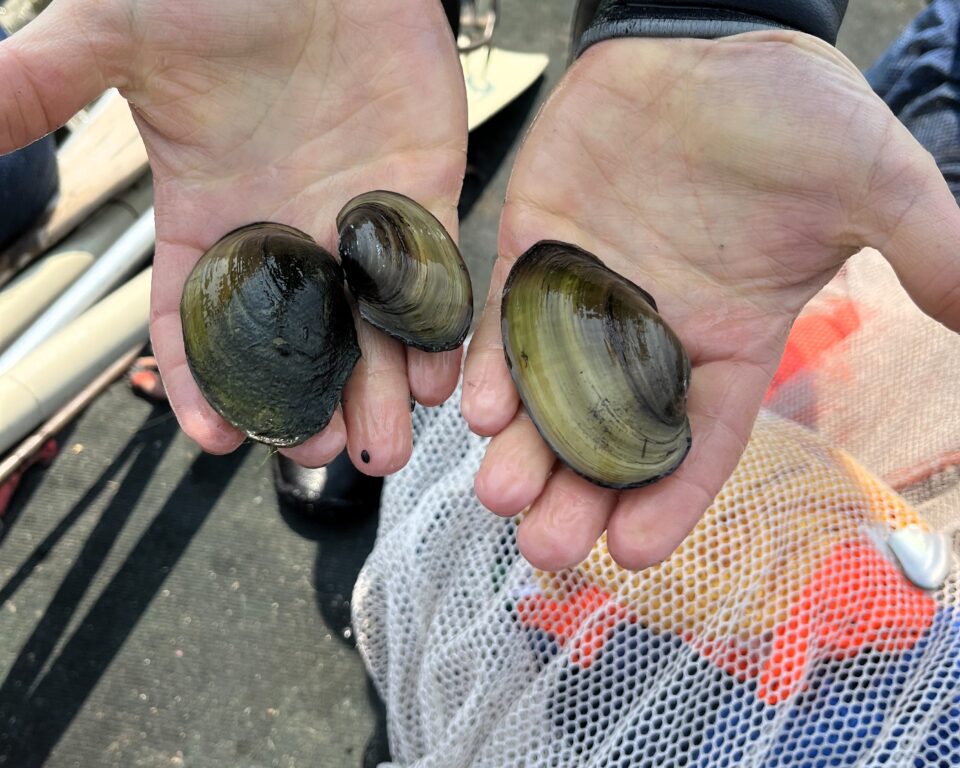
We were in the midst of a routine aquatic plant survey in Como Lake when we spotted something unexpected. Among the native aquatic plants was a large, brown mussel we later learned is a giant floater (Pyganodon grandis) – a common mussel in Minnesota but not previously reported in Como Lake.
We were thrilled to find native mussels in Como Lake. Mussels play an important role in aquatic environments. They improve water quality by filtering algae, bacteria, and other particles in the water, and are sensitive to pollution and habitat disturbances. Finding them in Como Lake indicates that lake water quality is good enough to support their presence.
After finding the mussel, we completed an informal Como Lake mussel survey with Ramsey County Soil and Water Conservation Division (RCSWCD), and Mark Hove, a research biologist at the University of Minnesota specializing in native mussels. During the survey, Mark taught us how to identify mussel species and ways to monitor them. We are partnering with RCSWCD to develop a Como Lake mussel monitoring plan for 2026.
Please note: native mussels are protected, and you cannot collect live mussels in Minnesota. If you pick up a live mussel, return it to the water immediately.
2. Highland Bridge Monitoring
Highland Bridge is a 122-acre community in Saint Paul at the site of the former Ford Assembly Plant. The City of Saint Paul, master developer Ryan Companies, and partners like CRWD took the time to carefully plan energy, waste, transportation, landscape, and water needs for the new community. The shared stormwater systems at Highland Bridge treat about 64 million gallons of rainwater each year, keeping an estimated 20 tons of sediment and 147 pounds of phosphorus out of the Mississippi River.
Before redevelopment, we monitored the polluted runoff in the outfall that flowed to Hidden Falls. In 2021, we stopped monitoring at that location because of construction. In September 2025, we installed a monitoring station at the new outlet location and began collecting water quality and quantity data. We can compare data from the new station to the data from the pre-redevelopment station to help us understand how the stormwater system is performing.
The award-winning (more on that in a moment) stormwater system includes several best management practices (BMPs) designed to reduce the peak amount of water flowing from the area to Hidden Falls. The system was also designed to remove pollutants, improving the water quality of the water flowing through Hidden Falls and to the Mississippi River.
On September 29, 2025, the green stormwater infrastructure system at Highland Bridge won the prestigious National Project Excellence Award from the Water Environment Federation. It is the first project in Minnesota to receive this national honor and sets a new standard for sustainable urban redevelopment.
3. New Monitoring Partnership with Saint Paul Regional Water Services
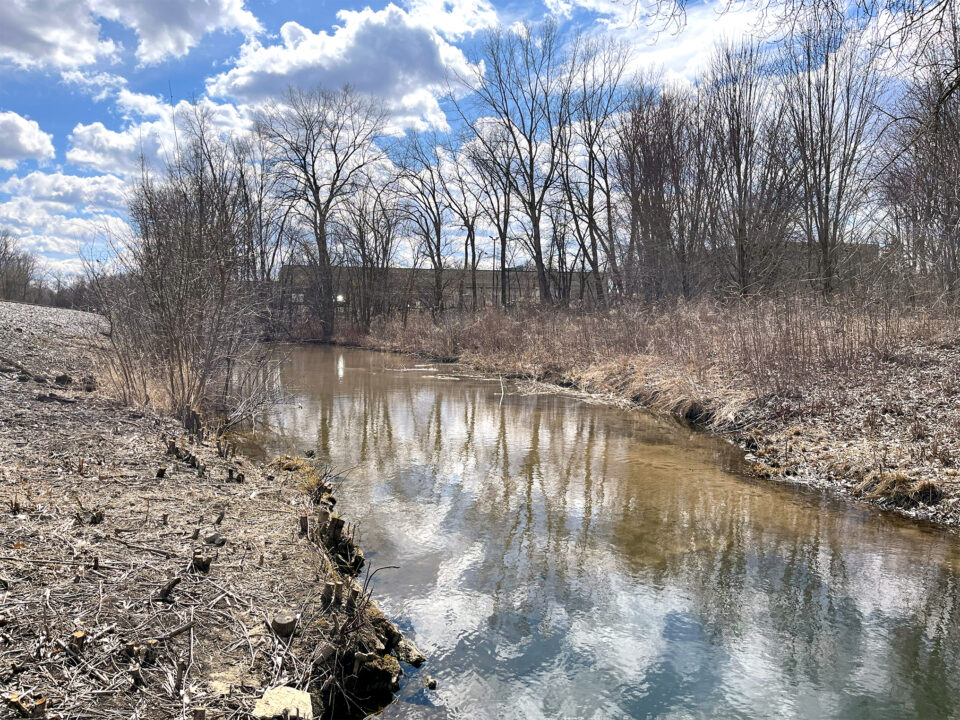
Saint Paul Regional Water Services (SPRWS) supplies drinking water to 450,000 people in the City of Saint Paul and several surrounding communities. The SPRWS McCarrons Treatment Plant is a 90-acre campus in Maplewood, directly east of Lake McCarrons. The stormwater from the site drains to an open channel stream that flows to our Trout Brook Storm Sewer Interceptor and eventually empties into the Mississippi River near downtown Saint Paul.
SPRWS received a CRWD Planning Grant to develop a Stormwater Master Plan for their century-old McCarrons Treatment Plant campus. The planning effort included refining water quality modeling to identify potential stormwater best management practices (BMPs). The model indicated that one of the site’s BMPs, a pond on the campus known as Jake’s Lake, was removing a lot of pollutants. However, due to the pond’s design, CRWD and SPRWS wanted to confirm that the model’s estimates were accurate. In 2025, we partnered with SPRWS to monitor the pond’s actual performance in reducing stormwater pollution and to help calibrate the model.
This partnership with SPRWS shows how collaboration can improve efficiency, save money, and solve problems. It also demonstrates the value of using monitoring data to answer a specific stormwater management question. By optimizing stormwater management on their campus, SPRWS is helping protect water quality in the Mississippi River, a drinking water source for millions of people downstream.
4. Rainy June Resulted in High Water Levels and Lots of Water Samples
In 2025, June rainfall totaled 8.26 inches. That’s 3.6 inches more than the month’s 30-year average of 4.58 inches. We also had four more days of rain than the 30-year average, for a total of 16 rainy days in June. The 30-year average provides a comparison to “normal” conditions and is calculated using climatological data from 1991-2020.
For us, more rain and more days with rain meant we were busy collecting many stormwater samples. When we are working during a rainstorm, we go out to collect water samples at various monitoring stations. The next day, we gather the samples collected by some of our stations using automatic samplers. So, more days with rain double our planned work. This is good news because more samples mean more data to analyze and more information about how our stormwater systems operate under different conditions.
More rain also led to higher-than-normal water levels in District lakes, ponds, wetlands, and the Mississippi River. Going into June, lake water levels were already higher than usual. Higher water levels in lakes can impact the shorelines, and in an urban watershed such as CRWD, the increased rain carries more pollution to our water bodies. We observed similar conditions last year: lots of spring rain led to algal blooms in many lakes.
5. Sharing Monitoring Knowledge
Our team presented three of our recent projects, featured below, at the National Monitoring Conference in March 2025. It was an honor to show the great work we do here at CRWD to a larger audience and share insights that our fellow water professionals may find helpful.
Monitoring Microplastics
- CRWD monitored microplastics as a part of our effort to evaluate contaminants of emerging concern, an action from CRWD’s 2021-2030 Watershed Management Plan.
- We collected samples from rain, stormwater and lakes to:
- Understand the prevalence of microplastics in District water resources
- Gain information on the types and size classes of microplastics found in samples
- Determine how microplastics may be affecting District stormwater BMPs
- We found microplastics in all samples, including precipitation, indicating that microplastics are present in all water resources in CRWD, and one avenue of entry is from rainfall. This highlights that the issue of microplastics is larger than just our District.
- We shared our sampling plan and findings to illustrate how to approach challenges with monitoring new contaminants.
Trout Brook Nature Sanctuary Iron-Enhanced Sand Filtration
- At Trout Brook Nature Sanctuary in Saint Paul, a series of stormwater ponds and wetlands flow to a restored open stream channel, cleaning the water as it meanders through the system.
- The ponds capture stormwater runoff from surrounding neighborhoods. The ponds filter water through iron-enhanced sand filtration (IESF) systems before entering the open channel, capturing nutrient pollution.
- We monitor the ponds to determine how well they remove pollutants, and how their design affects performance.
- Our monitoring data showed differences in pollution reduction based on each pond’s design. University of Minnesota researchers evaluated our data as part of a larger subset of monitoring data to understand improvements to pond design and maintenance for better IESF function.
- We shared information about the designs and performance of our IESF ponds, along with methods for how to analyze performance, to help others in designing and evaluating IESF ponds.
Best Monitoring Practices at Underground Stormwater Infiltration BMPs
- Underground stormwater infiltration is a common stormwater BMP in our urban watershed. These systems typically involve large underground chambers that fill with water when it rains, then the water slowly soaks into the soil below through holes in the pipes.
- Infiltration projects include: Curtiss Pond, Arlington Pascal, and CRWD’s grounds
- We had to develop methods to monitor the underground BMPs, since they can be challenging to access.
- We shared our monitoring pro-tips on what we’ve tried and what works best with our systems to help fellow monitoring professionals enhance their own monitoring methods.
What’s Next
As we wrap up another successful monitoring season, we are completing quality control checks of the data we collected before we begin analyzing and summarizing it for reporting. You can learn more in Insights into Water Quality Data with Our Monitoring Program. We compile our reports in the late winter, or early spring, each year before starting the data collection cycle again.
In the fall, we are also busy uninstalling our monitoring equipment that cannot remain installed over the winter due to cold damage. In the winter, we still conduct monitoring, although our field work is significantly reduced. We use this time to determine which monitoring should continue next year based on CRWD’s needs and specific projects, our long-term monitoring stations, and any new data requests, all balanced with staff capacity.
Thanks for following along with our season’s top five highlights!